The week before Christmas, Richard Meier died. His light went out. For some months, I had been messaging him almost every day. I would send a picture of the sky in Fife; he would reply with an adjective or an emoji. Richard had lung cancer. It was increasingly difficult for him to breathe.
So I had been sending him the sky. Months of sky, interspersed with occasional trees or moss or fungi. Snaps taken on my morning woodland walks, during which I was breathing easily, painfully conscious that he wasn’t.
Each time an order for his book (After the Miracle) popped in, I would send a picture of the packet on its way into the postbox: ‘You’re off to Manchester today.’ ‘Or a Miracle off to Perth … Dublin … Ohio etc.’
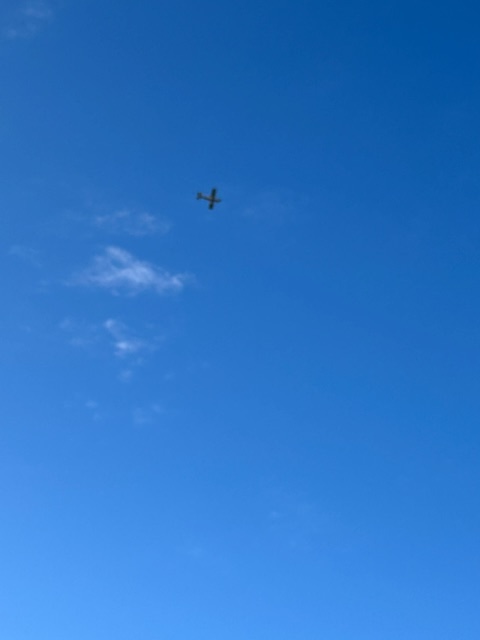
The last sky I sent him was blue with a tiny turbo-prop plane circling. There had been no word for days.
The Miracle is a good book. He’s a good poet. I was privileged to work with him. It was the last book I will publish through HappenStance Press and it was a strong ending. A handful of Richard’s poems seem to me to be perfect. He drops words into space like pebbles in water, like clouds into sky.
One section of After the Miracle is a homage to the Japanese poet Takuboku Ishikawa. Originally I wondered whether these short pieces would even work in a book (they are so very brief). I felt there had to be only one per page, but that meant an awful lot of white space. Often readers skip past short poems, looking for something more meaty to get hold of. Like skipping through photographs of sky, looking for faces.
I thought about Richard’s Japanese-style poems for a long, long time. Each has only three lines (like many of Ishikawa’s). But they’re not syllabic structures. Their size, in terms of both sound and line length, varies a lot. What they have in common is intensity. They pack a three-line punch.
There’s something else unusual about them. Traditional Japanese short forms don’t have titles but these poems of Richard’s have a sort of afterthought title below the text – over to one side, right-justified, inside brackets. I haven’t seen this done before. When I asked him, he said ‛I felt they needed something.’ Perhaps he himself was puzzled by the whole thing.
It struck me later that the un-titles were indispensable. They’re a way of giving the reader pause, holding them back, offering a possibility of what the poem might mean (and might not). Ideally, you then read the poem again, a little differently. The un-title is tentative – none of the imperiousness of normal titling.
Here’s one of the Japanese-style poems from After the Miracle:
the plain white biscuit tin
you gave me on our ten-year anniversary
contains my medicines now
[A marriage]
The poem would work without the un-title. And WordPress won’t let me move it over to the right hand side, where it should be (please do your best to visualise it as it should be.) But ‘A marriage’, as afterthought, does various things. First, it’s clear from the book as a whole that the marriage is broken, so the noun is emotive. Second, it’s only ‘a’ marriage, not a definition of the wedded state. And then all sorts of other things. The poem is stripped back to plainness. No punctuation, not even at the end. No capital letters. Yet the structure of the statement is crystal clear. And the plain white biscuit tin is curiously beautiful, with or without medicines, and more beautiful (mysteriously) because of the absence of commas. And the sound of tin (such an echo-ey metal) echoes tinnily in ‘plain’/‘ten’/‘contains’ and ‘medicines’. And there’s the long and nostalgic word ‘anniversary’ concluding an elegant, flourishing line – and the stolid contrast as we leave the past and move into the present; from then … to ‘now’. In the second line (the then line) there’s ‘you’ and ‘me’ and ‘our’, as in a marriage. In the third line (now), there’s just ‘my’, and the ‘me’ inside ‘medicines’. Oh there’s heart-ache here, yes. But so beautifully controlled, so lovingly shared.
And each word absolutely precise. The best words in the best order. Again, I think of pebbles dropped into water, and the ripples that spread out from them. The un-titles in brackets catch the ripples and send them back. When you turn the page, the ripples are still spreading inside your head. Or so it seems to me. I marvel at a poem that can work like this.
It’s a myth that some books of poetry (the winners in an imaginary race) are full of perfect poems. They never were, nor will they be. In a strong collection, there’s fascinating work in process, and perhaps a few perfect poems, or poems with perfect parts.
Sometimes, the poems that affect you most deeply have flaws, and sometimes such flaws are vital. The poet, of course, tries for perfection, gets the poem as close to its ideal as s/he possibly can. But perfection may happen by accident. Even the poet doesn’t understand it. Nor is understanding necessary. You just read it, and you feel it, and you marvel.
